An autonomous agent moved funds at 3:11 a.m. The transfer cleared, the counterparty confirmed, and the logs said it was approved. The only thing nobody could answer the next morning was whether the approval was real — or a line written after the fact. Once software acts faster than people can watch, the audit trail stops being paperwork and becomes the system of record. Cryptographic verification is what makes that record worth trusting.
The gap between "it ran" and "it was allowed"
Most systems log what happened. Far fewer can prove it. A log is a claim; a claim can be edited, reordered, or quietly backfilled, and a database row never announces that it was changed. That is fine when a named human signs off on every action. It falls apart when the actor is a model issuing thousands of decisions a day with no one in the loop.
The instinct is to ask the operator to trust the operator. Escrypto inverts that. Instead of "trust us, it was authorized," it produces evidence the other side can check independently — without access to the system, the team, or any privileged view. The promise narrows from we believe this is correct to here is the proof, verify it yourself.
The distinction matters most precisely when the stakes are highest. A read-only dashboard can afford to be approximate. A system that moves money, signs contracts, or provisions infrastructure on its own cannot, because the cost of an unverifiable action is not a wrong number on a screen — it is a transfer that already settled, an obligation already incurred. Cryptographic verification moves the burden of proof off the operator and onto the math, where it does not depend on anyone's word.
Trust is a promise. A signature is a fact. Build on the fact.
What cryptographic verification actually checks
Cryptographic verification is not one mechanism but a small set of guarantees, each answering a different question about an action.
- Cryptographic signature verification answers who authorized this — a private key signs the intent, and the public key proves the signer without revealing the secret.
- Cryptographic integrity verification answers was this tampered with — a hash chain over the audit log means any edit, anywhere in history, breaks every link after it.
- Cryptographic identity verification answers is this actor who it claims to be — keys bind an agent, a service, or a person to the actions taken in their name.
Together they cover the questions that matter after an autonomous system has already acted: not "did something happen," but "who allowed it, in what state, and has the story changed since."
The loop: authorize, verify, execute, prove
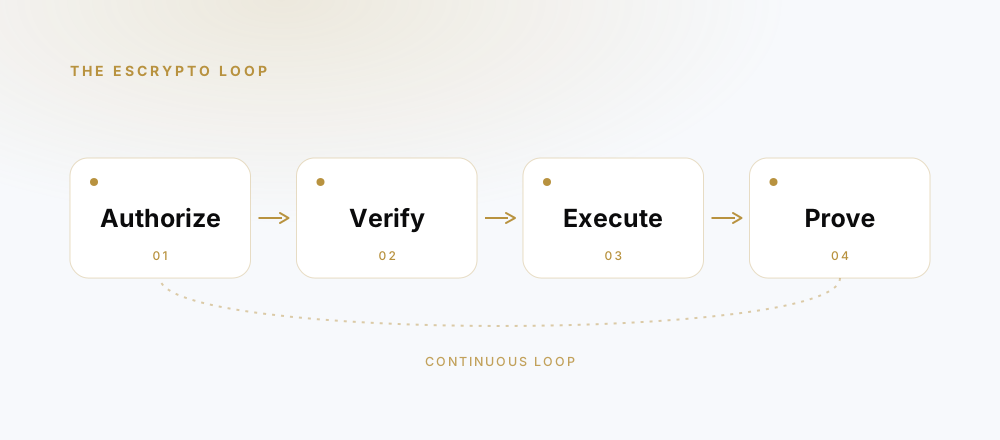
Escrypto runs every consequential action through four steps, the loop on the diagram above.
Authorize action. Before anything executes, the intent is signed. The signature binds a specific actor to a specific operation at a specific moment, so authorization is a cryptographic fact rather than a flag in a table.
Verify state. Escrypto checks the world is what the action assumed — balances, permissions, prior steps — against the signed record. Cryptographic checks here catch the case where reality drifted between approval and execution.
Execute. Only then does the action run. Execution is the narrow, well-guarded middle of the loop, not its first move.
Prove history. Every step is written to an append-only audit log, hash-chained so the sequence is tamper-evident. The proof is a byproduct of running, not a report assembled afterward.
The primitives under these steps are deliberately plain: cryptographic checks at the gate, audit logs that cannot be silently rewritten, and deterministic replay that can reconstruct exactly what occurred.
Replay is the proof you can rerun
A signature tells you an action was authorized. Deterministic replay tells you what the action did — by reconstructing it from the signed inputs and the logged state, step for step, until it lands on the same result. Same inputs, same record, same outcome, every time.
This is the difference between an explanation and a proof. An incident review that depends on people recalling intent is an explanation. A replay that derives the identical outcome from the recorded inputs is something an auditor, a regulator, or a counterparty can run themselves. When the numbers move, "we think it went this way" is replaced by a transcript anyone can re-execute and confirm.
That property is what makes Escrypto usable as digital asset infrastructure rather than a logging add-on. Moving value demands more than a record that an action occurred; it demands a record that holds up when someone hostile, careful, or simply unfamiliar comes to check it. The same machinery runs self-hosted, so the keys, the logs, and the proofs stay inside the boundary you already control instead of behind someone else's API.
Designed to be doubted
Escrypto is built for the reviewer who assumes nothing — the auditor who will not take a log at face value, the partner who wants to confirm a transfer without a meeting, the engineer reconstructing an incident months later. Each gets the same answer from the same evidence, no privileged access required.
The shape of accountability is changing with it. For decades, control meant a human in the loop signing off in real time. That gate does not scale to systems making thousands of decisions an hour, so the loop is moving from before the action to after it — from approval to proof. The constraint is no longer how fast a person can say yes, but whether every action leaves a record that holds up under scrutiny.
As more of what software does happens without a person watching, the question stops being whether a system is fast or clever and becomes whether it can be checked. Cryptographic verification is how autonomous systems earn the right to act unsupervised: not by asking for trust, but by making every action one anyone can prove.